
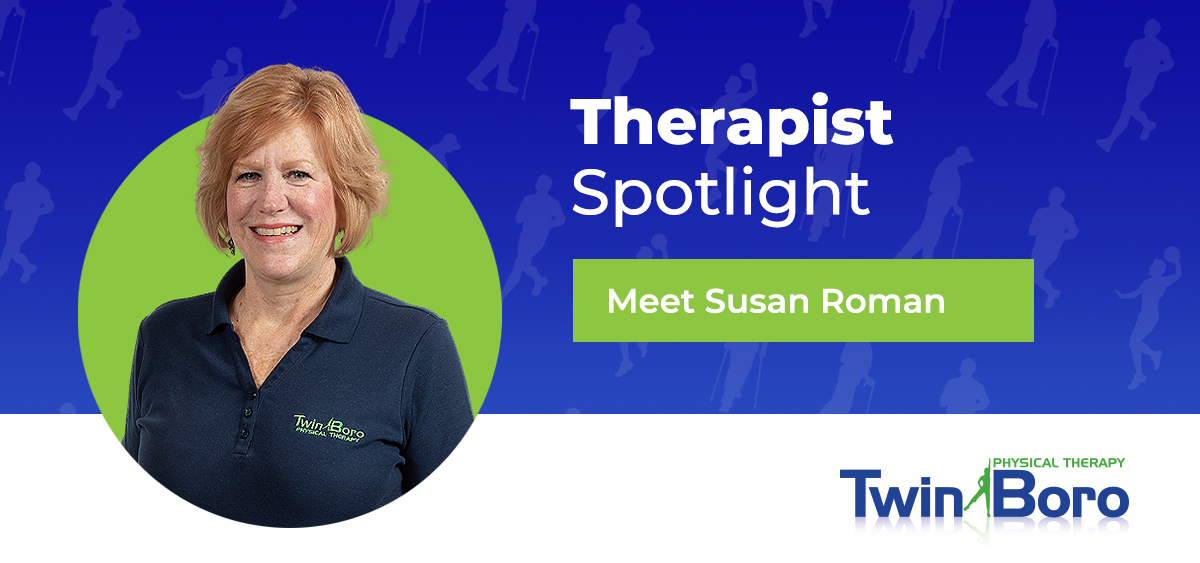
Some physical therapists can trace a specific instance when it just “clicked” that the profession was right for them. This is true for Susan Roman, PT, who considers a fortuitous career day at high school in 1977 to be this moment. At the time, she wasn’t even aware that physical therapy existed, as the field was still young and only beginning to grow in popularity. But after a gregarious physical therapist explained what he did for a living to her school, “It opened up a new world for me,” Susan says.
This spark led Susan to shadow the therapist that had presented, and she learned a great deal about the inner-workings of physical therapy during this time. Susan found the physical therapist to be positive and inspiring while she shadowed him, as he was willing to take on even extremely difficult cases like patients with spinal cord injuries. She also felt that physical therapy was different compared to other healthcare fields, and the more she learned, the more it solidified her desire to become a therapist.
Since physical therapy schooling was still rare at this point, Susan then had to figure out a way to carve out her own educational path. There was no physical therapy assistant (PTA) programs in her home city of Philadelphia, but she was able to get sponsored by Philadelphia Community College to attend Lehigh County Community College (LCCC) in Allentown, PA. After obtaining her associate’s degree in physical therapy assisting from LCCC in 1980, she began work in the acute care department of JFK Hospital in Philadelphia. She also worked as PTA in several departments at Good Shepherd Rehabilitation Hospital in Allentown Hahnemann University Hospital in Philadelphia, which exposed her to a number of specialties and helped her realize that she wanted to focus her career in orthopedics.
Susan moved to New Jersey in 1987 and worked in private orthopedic practices before joining the Twin Boro Physical Therapy staff in 1989. She started off as a part-time PTA while pursuing her Bachelor of Science in physical therapy from the University of Medicine and Dentistry of New Jersey, and then was taken on as a full-time physical therapist after graduating in 1991. Early on, Susan was fortunate to provide care in several settings, as she began at the Parlin office and then rotated between the Union and Westfield locations, and even did and a stint at the office for the General Motors plant in Linden. She eventually landed on Union as her permanent place of practice and has been there exclusively for about 25 years.
Throughout her time at Twin Boro, Susan has primarily worked in orthopedics, which has given her the chance to manage a wide range of conditions and patients. It has also allowed her to utilize a whole-body approach for each patient, which she’s always preferred instead of focusing only on a specific joint or body part. Every treatment program she designs is unique, but she frequently uses manual therapies like joint mobilization, soft-tissue mobilization, myofascial release, and occasionally instrument-assisted soft-tissue mobilization like The Graston Technique. She combines this with stretching and strengthening exercises, neuromuscular re-education, and functional training that is all geared towards progressing patients back to full function and recovery.
Another hallmark of her treatment approach is a strong emphasis on patient education. While some other doctors may brush over this part of the visit, Susan feels that it’s a primary obligation of physical therapists to properly educate their patients on their injury and treatment plan.
“So, on their first visit, I’ll explain where the patient is at (acute, subacute, or chronic) and break down specifically what’s going on with their tissues and other structures,” she says. “Then as they progress, I’ll tell them what phase they are at in the healing process and show them what they’re capable of doing at each stage, as well as what to expect next.”
Most patients have lots of questions about whether things are going to improve and when, so one of Susan’s constant goals is to address any of these concerns while also informing them that healing takes time. Susan has found that when patients better understand their condition, they are far more likely to be compliant with their treatment program, which always leads to better outcomes.
During her career, Susan has also remained active in continuing her education, having taken numerous courses through Great Lakes Seminars and other organizations. Collectively, this has included topics such as manual therapy, the McKenzie Method, the Maitland Concept, When The Foot Hits the Ground, and instrument-assisted soft-tissue mobilization. These courses have helped Susan to expand her skill set in order to more accurately meet the demands of each patient with the most appropriate interventions for their condition.
“Even after 40 years in this field, it is still exciting to me because every patient is different, and I cannot presume on one plan of care,” she says. “I am passionate about meeting new people almost every day and listening to their stories and figuring out their causes of pain and disability. Then I get to design a unique program for each patient.”
Outside of the office, Susan enjoys hiking, skiing, traveling, reading, working out, and spending time with her adult children.